|
|
|
 |
|
Here are a useful list
of answers to common questions. Click on a
question below to go to its answer, and click on
the
TO TOP
button
to go back to the top of this page. If you
have any further questions, please feel free
to contact us.
|
|
|
|
|
|
|
|
|
Tree benefits
within the urban
environment can be
broadly divided up
into 5 sections:
- Social
Benefits: Trees
have been a part
of our existence
since
pre-historic
'man'. Our
attachment to
trees is what
social
anthropologists
term;
Dendro-psycosis.
They are apart
of our 'human'
fabric. The
effect of a
treed
environment can
easily be
displayed buy
research that
has shown that
hospital
patients
recovering from
surgery, do so
at an
accelerated
speed if their
rooms have a
view of trees.
- Community
Benefits: Even
though trees may
be private or
state property,
their size often
makes them part
of the community
(Johannesburg
sky line, is a
point in view).
With proper
selection and
maintenance,
trees can
enhance and
function on one
property without
infringing on
the rights and
privileges of
neighbours.
-
Environmental
Benefits: Trees
alter the
environment in
which we live by
moderating
climate,
improving air
quality,
conserving water
and harbouring
wildlife.
- Economic
Benefits:
Property values
of landscaped
homes are 5-20%
higher than
those of
non-landscaped
homes.
- Trees
require an
investment:
Trees provide
numerous
aesthetic and
economic
benefits but
also incur some
costs. Money
spent on buying
good healthy
trees can be an
investment that
can only keep on
'growing'. It is
in the
selection,
installation and
maintenance of
trees that the
money invested
on the services
of an Arborist
can be seen as
money wisely
spent.
|
|
|
|
|
|
|

|
|
|
|
|
|
|
Trees
provide significant
benefits to our
homes and cities,
but when they fall
and injure people
and damage property,
they are
liabilities. Taking
care of tree hazards
makes your property
safer and prolongs
the life of your
trees.
The advise of a
professional tree
care practitioner,
cannot only make
your property safer
but can increase the
long-term value of
your property.
Remember that the
wrong advise and the
application of
incorrect pruning
methods can lead to
a myriad of tree
complications that
can cost you a
fortune in the
future.
|
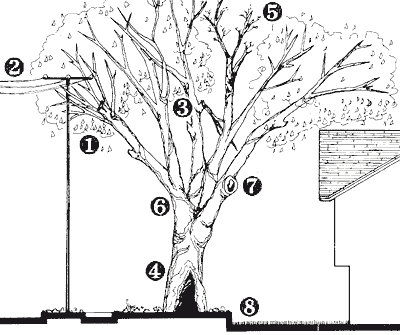
Examples
of defects
present in
urban trees:
- Re
growth
from
topping,
line
clearance
or other
pruning.
-
Electrical
line
adjacent
to tree.
-
Broken
or
partially
attached
branch.
- Open
cavity
in trunk
or
branch.
- Dead
or dying
branches.
-
Branches
arise at
one
point on
the
trunk.
-
Decay
and rot
present
in old
wounds.
-
Recent
change
in
grade,
soil
level or
other
construction
|
 |
|
|
|
|
|
|
|
|
|
|
|
|
|
|
The
purchase of a tree
should be looked on
as a lifetime
investment. How well
the tree and in
effect your
investment grows
depends on the type
of tree and the
location you have
selected for that
tree to grow in, the
care provided for
that newly planted
tree and the follow
up treatment that
the newly planted
tree receives.
The best possible
time to plant trees
is during there
dormant period, best
indicated after leaf
drop in the winter
months or at early
spring when the buds
are ready to burst.
Generally, any tree
or sapling can be
planted year round
if it is in good
health and is
planted CORRECTLY.
Correct tree
planting is
something that is
extremely neglected
and is subject to
many years of bad
procedure passed
down from generation
to generation. What
follows is a brief
explanation of how
to correctly plant
your tree to ensure
optimum growth and
health.
- Identify the
root flare on
the tree.
- Using the
root flare as
indication of
what must be
placed above the
ground;
- Dig a
shallow broad
'bowl' shaped
hole, only dig
the depth in
accordance with
the distance
from the base of
the flare to the
bottom of the
root ball.
- Straighten
the tree in the
hole.
Backfill the
hole, gently but
firmly. Every
1/3 of the way
gently compact
the soil filled
into the hole.
- Try to
absolutely avoid
staking the
tree, if this is
not possible
then make sure
that the stakes
are away from
the root ball
and trunk of the
tree and are
left on as short
a time as
possible.
- MULCH THE
BASE OF THE TREE
(see section
devoted to mulch
and its
importance in
tree health).
|
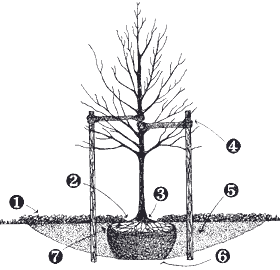
How to
plant a tree
properly :
- 2-4"
layer of
mulch.
- Keep
mulch
1-2"
back
from
trunk.
-
Trunk
flare.
- Use
two
opposing,
flexible
ties
when
staking
is
necessary.
-
Gently
pack
back-fill,
using
water to
settle
soil
around
root
ball.
- Set
ball on
firmly
packed
soil to
prevent
settling.
- Cut
burlap
and rope
away
from top
third of
root
ball.
|
 |
|
|
|
|
|
|
|
|
|
|
|
|
|
|
At URBAN
FOREST there is
above all a desire
to enhance our
natural heritage
within the man made
city. Part of that
ambition is the need
to recycle all of
our waste matter, to
ultimately become a
zero waste company.
All timber generated
from our tree care
sites is recycled
with the use of our
shredder chippers,
this ‘mulch’ is then
reused in our tree
planting programme's
or is then converted
into an organic
COMPOST and sold
back to our
customers to help
enhance the health
and vitality of
there gardens.
The use of natural
organic matter in
the gardens of our
customers helps with
creating a natural
cycle that so-often
is not present in
the urban
environment, very
often this ‘waste’
material is dumped
onto our city
landfills, this
process is extremely
taxing on the amount
of space available
within the city for
the disposal of
waste and it also
greatly increases
the amount of
methane released
into the breathing
air of the city.
This costly,
wasteful and
senseless disposal
of our organic waste
is what URBAN FOREST
is striving to
correct and develop
into a viable,
sustainable
alternative that can
enhance the
city/environment
that we live in.
COMPOST can be
delivered or
collected from our
depot at your
convenience. |
|
|
|
|
|
|
|
|
|
|
|
|
|
|
|
URBAN
FOREST provides year
round, exotic hard
wood for the purpose
of burning. This
contributes to the
alien eradication
programme endorsed
by WORKING FOR WATER
to help save our
indigenous species
from the invasion of
alien trees.
Our wood is cut to
size, split and
dried for easy use.
The specific
requirements of the
oven wood burner (Morso
etc.) have been
considered in the
processing of our
firewood.
URBAN FOREST also
provides for
delivery of
firewood, at a
minimum of 2 cubic
meters or one can
collect from our
depot in Midrand. |
|
|
|
|
|
|
|
|
|
|
|
|
|
|
An
Arborist is a
specialist in the
care of individual
trees. Arborists are
knowledgeable about
the needs of trees,
and are trained and
equipped to provide
proper care. Hiring
an Arborist is a
decision that should
not be taken
lightly. Proper tree
care is an
investment, which
can lead to
substantial returns.
Well cared for trees
are attractive and
can add considerable
value to your
property. Poorly
maintained trees can
be a significant
liability. Pruning
or removing trees,
especially large
trees, can be
dangerous work. Tree
work should be done
by those trained and
equipped to work
safely in trees. |
|
|
|
|
|
|
|
|
|
|
|
|
|
|
|
MULCH is
the least used and
least known about
product in the
Johannesburg garden.
This is a quite
amazing fact based
on the following
stats:
- It saves up
to 70% in water
usage.
- Is
generated/created
by the garden
itself.
- Creates a
natural 'Forest
Floor' effect
that your plants
love to grow in.
- 'Feeds' your
trees at natural
rate, a rate
that they are
designed to
absorb at.
- Is used
extensively in
most developed
countries that
have a far
greater average
rainfall than
Johannesburg
does.
- Is used in
gardens around
the world where
it is not
possible to have
a gardener part
or full time.
- Is used by
Landscape
architects as a
design element
within the
garden.
The above aspects
are just an overview
of why it is so
amazing that MULCH
is so underutilized
in our gardens.
URBAN FOREST creates
various types of
mulch to suit
various needs of our
different customers.
- Raw mulch
is the mulch
delivered
straight off the
truck from site
where the mulch
has been
chipped.
- It
contains a
lot of leaf
matter.
- Various
sized pieces
of chip.
- A rough,
highly
textured
look that is
somewhat
untidy, but
still
provides the
exact same
benefits of
any other
more
processed
mulch.
- Due to
its 'raw'
state, it
will require
more
nitrogen
from the
soil to
facilitate
the
breakdown
process. So
it is not
advisable to
use this
type of
mulch on top
of soils
that are
nitrogen
deficient.
- Screened
Mulch is a
processed mulch
that is screened
by URBAN FOREST
at our depot in
Midrand.
- The
'look' of
the mulch is
far more
uniform and
tidy.
- The leaf
matter is
largely
broken down.
- Will
require far
less
nitrogen
from the
soil as the
decaying
process has
already
begun at our
yard.
|
|
|
|
|
|
|
|
|
|
|
|
|
|
|
|
Lawn
dressing is just a
further process in
URBAN FORESTS
recycling programme.
We produce a highly
refined product from
our organic compost.
The finely sieved
and consistent end
product is perfect
for the development
of a lush lawn that
is vigorous and
healthy. |
|
|
|
|
|
|
|
|
 |
|
|
|
|
|
|